Authentic GP Motorcycles from Decades Past Compete at the Imatra Grand Prix
The European Series Road Racing (ESR), a new motorcycle road racing championship launched this year, is not the only attraction at the Imatra Grand Prix in July. The two-stroke motorcycles of the International Classic Grand Prix (ICGP) classes evoke memories of the golden World Championship years of the Imatra Grand Prix, when Jarno Saarinen secured his world title.
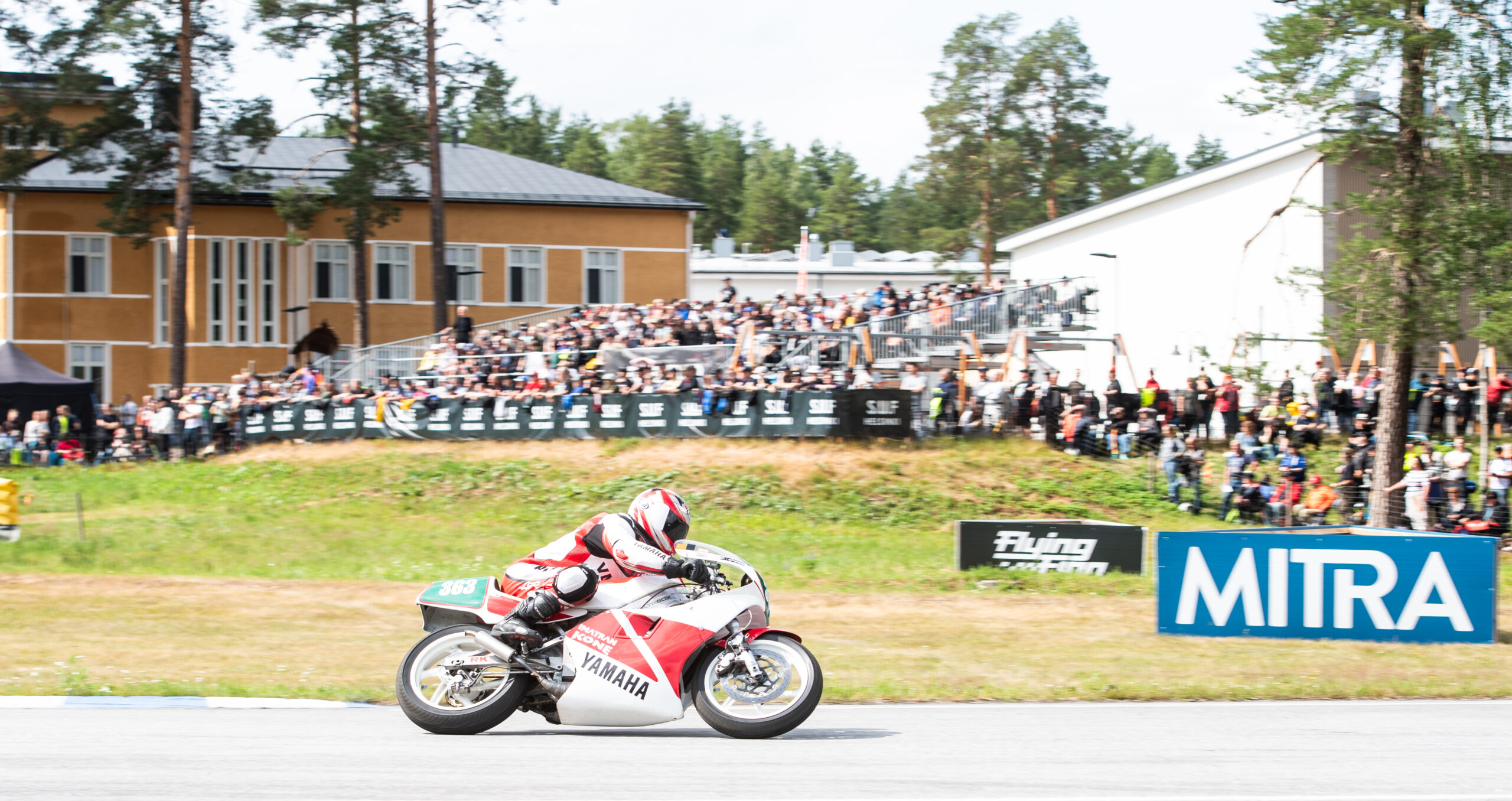
More than 50 years ago, Jarno Saarinen became the only Finnish rider to win a solo road racing motorcycle World Championship title to date. The rider from Turku clinched his championship at Imatra in 1972. Much water has flowed down the Vuoksi River since then, but visitors can still experience the spirit of that era this summer in the very same surroundings. At the Imatra Grand Prix road racing event, held from July 3–5, competitors will race in the International Classic Grand Prix (ICGP) classes featuring 250cc and 350cc two-stroke motorcycles manufactured between 1974 and 2008. These machines are exclusively genuine Grand Prix motorcycles from the World Championship era; modified production motorcycles are not permitted, except for certain specific exceptions.
“ICGP represents the history of the Imatra Grand Prix. If spectators want to experience the atmosphere of the old days and the scent of two-stroke engines, this is the place. In addition to major manufacturers such as Yamaha and Honda, there will also be bikes from MZ and two Rotax machines, which may not be as familiar to everyone,” says Juha Suikkari, Secretary of the Imatra Grand Prix.
ICGP is often regarded as the MotoGP of vintage motorcycles. In keeping with the spirit of the classes, competitors are true gentlemen who share deep respect for one another. Participants include former Grand Prix riders as well as enthusiasts passionate about classic racing motorcycles. ICGP was established as a championship series in 1999, but the COVID-19 pandemic effectively brought the regular championship rounds to an end. Nevertheless, races in these classes continue as standalone events in several countries, with a shared passion for preserving the heritage of the sport.
From Imatra’s perspective, it is significant that the first international TT motorcycle race (Tourist Trophy, a predecessor term to today’s road racing and circuit racing) was held along the banks of the Vuoksi River in 1962. Two years later, the Imatra Motor Club organized its first World Championship event, which became known as the Imatra Grand Prix. Saarinen crowned his 250cc World Championship campaign by winning the Imatra Grand Prix in 1972. Other successful Finnish riders of the era included Matti Salonen, Martti Pesonen, Teuvo Länsivuori, Pentti Korhonen, Eero Hyvärinen, and Johnny Wickström. The World Championship era at Imatra ended in 1982. The legendary street circuit had become outdated and no longer met the requirements for World Championship competition, while Grand Prix racing increasingly moved to permanent racing circuits. During several years, the Imatra Grand Prix was recognized as the best-organized event in the World Championship series.
Classic and Modern Superbikes Compared
In addition to the ICGP classes, this year’s Imatra Grand Prix will offer nostalgia and echoes of history through the Classic / Retro Superbike category. These motorcycles are primarily four-stroke machines from the 1970s through the 1990s, with engine capacities around the 1000cc mark.
Now being held for the 60th time, the Imatra Grand Prix will also bring together an outstanding lineup of Europe’s contemporary road racing elite in the fourth round of the European Series Road Racing (ESR) championship. Alongside the ESR Superbike class for 1000cc motorcycles and the ESR Supersport class for 600cc four-stroke motorcycles, competitors will also race in the exciting Open Superbike and Open Supersport categories on the Jarno Saarinen Circuit Imatra street course.
The Open Superbike class is expected to feature many of the same Finnish and international riders seen in ESR Superbike, and the same applies to Open Supersport and ESR Supersport. Many riders are likely to compete in all four classes aboard different motorcycles.
“Without ICGP, there would only be four-stroke motorcycles at the Imatra Grand Prix. Through the Classic and Retro classes, spectators can compare modern superbikes with their counterparts from the 1980s,” Suikkari points out.
Even more international flavor will be added by the sidecar category, led by road racing World Champion Pekka Päivärinta and several other foreign World Championship gold medalists.
King of Imatra Concludes the Event
The second Open Superbike race on Sunday—the final race of the entire event—carries additional significance, as the prestigious King of Imatra title will be awarded to the best-performing rider of the weekend.
The event opens on Thursday with the official opening ceremony. Practice sessions and qualifying take place on Friday, while the races themselves are held on Saturday and Sunday. A detailed event schedule is available on the Imatra Grand Prix website:
Late rider registration is open until July 2 at 12:00 noon:
www.imatranajo.fi/kuljettajille
60th Imatra Grand Prix
July 3–5, 2026
Jarno Saarinen Circuit Imatra
www.imatranajo.fi
www.facebook.com/imatranajo
www.instagram.com/imatranajo
Tickets
www.lippu.fi/artist/imatranajo
Official Event Programme
Vauhdin Maailma 6/2026
Imatra Motor Club (IMK)
www.imk.fi
European Series Road Racing
esroadracing.com
Image: Heidi Koivunen